.svg)

Why Cuddling with Your Dog Is Actually Good for You
We don't argue with science. And after reading this, you won't want to either.
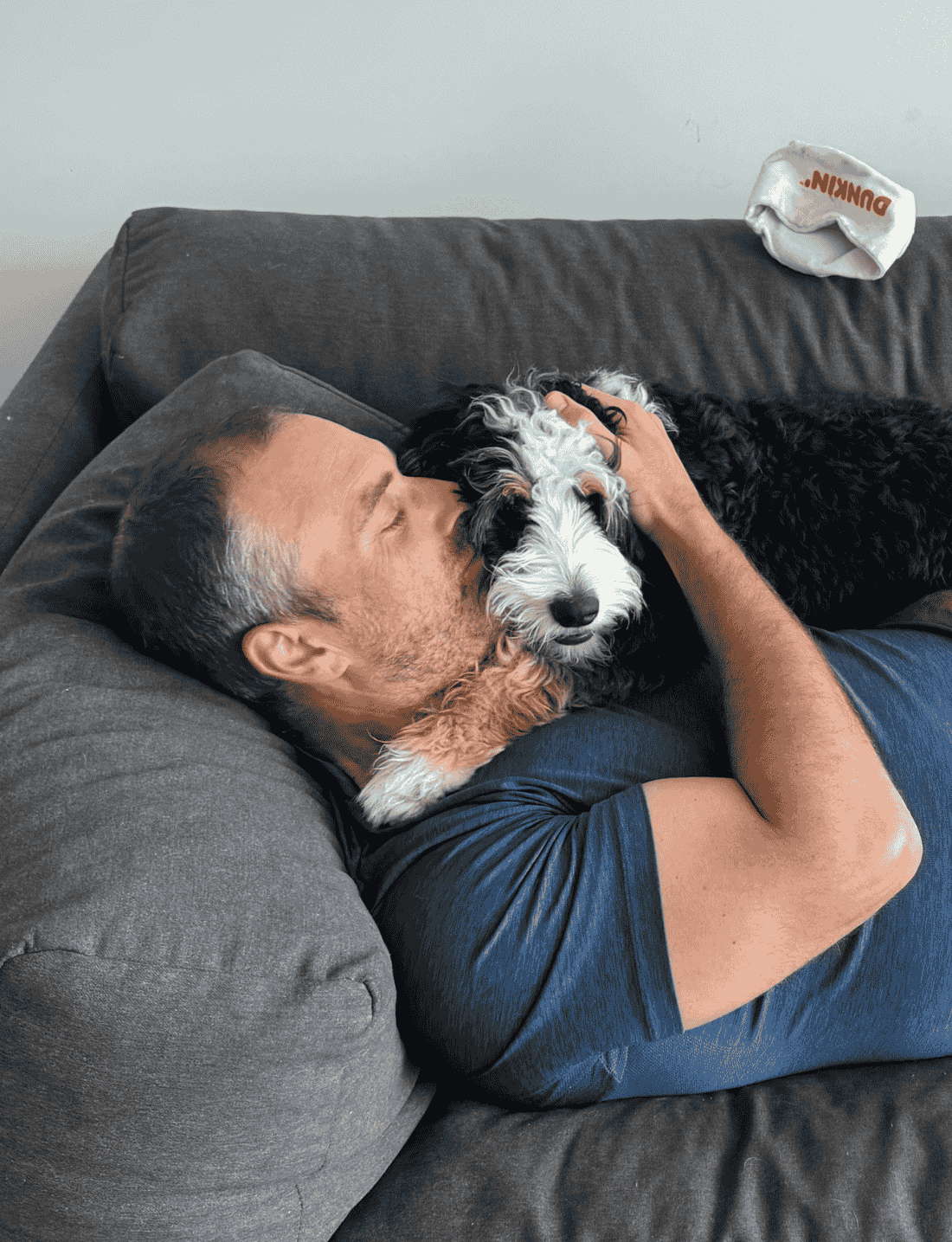
There's a specific kind of peace that happens when your dog sighs, rearranges themselves against your legs, and settles in for the night. Dog people know it. It's not just comfort — it's something older, something wired into the bond between humans and dogs that goes back thousands of years. Turns out, science has been quietly catching up to what we already knew in our bones.
Here's what's actually happening when you let your dog curl up close.
1. You're Both Getting a Hormone Hit — and That's a Good Thing
The moment you start petting or snuggling your dog, both of your brains release oxytocin — the same bonding hormone involved in human attachment, trust, and love. This isn't metaphor. It's biochemistry. A landmark study out of Japan found that even sustained eye contact between dogs and their owners triggered oxytocin spikes in both species — a feedback loop of mutual affection that's almost uniquely shared between humans and dogs. No other domesticated animal does this with us the way dogs do.
So when Bailey Bear tucks her head under your arm and you feel that rush of warmth? That's ancient chemistry, confirmed by modern science.
2. Your Cortisol Doesn't Stand a Chance
Stress hormones are no match for a sleeping dog. Research has shown that time with dogs — especially physical closeness — measurably lowers cortisol, the primary hormone your body releases under stress. The effect is real enough that therapy dog programs are now used in hospitals, universities during finals, and crisis response settings. Your dog's steady breathing, their weight against you, the rhythmic rise and fall of their chest — it signals safety to your nervous system in a way that's hard to replicate otherwise.
For anyone who lives alone, works high-pressure hours, or just carries a lot — a dog at bedtime is doing real regulatory work, not just keeping you company.
3. The Sleep Benefits Are More Nuanced Than You Think
Sleep research on human-dog co-sleeping is more interesting than the headlines suggest. A Mayo Clinic study found that people who slept with dogs in the room — even on the floor or in a crate — reported better sleep efficiency than those without. The caveat: dogs in the bed occasionally disrupted sleep, but owners still rated their sleep quality as high. The sense of security, the routine, the familiar presence — those psychological factors appear to outweigh the occasional paw to the face.
For light sleepers or people prone to nighttime anxiety, the grounding presence of a dog can quiet the spiral that keeps you awake.
4. They're Running Warmer Than You — and That's the Point
Dogs run a body temperature of 101–102.5°F, slightly higher than humans. That warmth isn't incidental to the cuddle experience — it's central to it. Gentle, ambient warmth supports muscle relaxation and is associated with faster sleep onset. It's part of why heated blankets, weighted covers, and warm baths before bed are all recommended by sleep specialists. Your dog is simply the most animated version of all three.
5. The "Security Blanket" Effect Is Real
This one is harder to quantify but no less documented: dogs are alert even in sleep. Their hearing and smell remain partially active, and many dogs will wake and respond to environmental changes before their owners are aware of anything. For people with anxiety — particularly around home security or nighttime vulnerability — this passive vigilance registers on a subconscious level. It reduces hypervigilance, one of the more exhausting symptoms of chronic stress. Knowing something is watching over you, even a fluffy something, changes how your brain classifies rest.
A Few Notes on Doing It Well
Co-sleeping works best with a little intention behind it. Large dogs especially benefit from their own designated space within the bed — a blanket or cushion that signals "your spot" — which helps with boundaries and keeps the sprawl manageable. Wash your pet's bedding regularly, keep up with grooming, and if allergies are a factor for anyone in the household, consider an air purifier. The goal is comfort for everyone involved.
The Bottom Line
The bond between humans and dogs isn't sentiment — it's biology, psychology, and thousands of years of co-evolution. When your dog chooses to be near you at night, they're not just being cute. They're participating in one of the oldest wellness rituals we have.
So go ahead. Fluff the pillows. Let them in.
Sweet dreams really are better with your dog close.